Angular contact ball bearings are usually used in the form of multiple sets of single-row or double-row bearings, especially in the field of machine tools and precision machinery equipment, meeting their high speed and high rigidity requirements.
Angular contact ball bearings are a type of bearing that can withstand combined loads in both radial and axial directions. Compared to deep groove ball bearings, they have stronger load-bearing performance. They are usually used in the form of multiple sets of single-row or double-row bearings, especially in the field of machine tools and precision machinery equipment, meeting their high speed and high rigidity requirements.

There are several types of angular contact ball bearing pairings:
Back-to-back Configuration:
Two single-row angular contact ball bearings are mounted back-to-back. Their contact angles are spread out along the axis of rotation, effectively supporting bidirectional axial loads and offering strong resistance to deformation. This assembly method can provide the equipment with higher rigidity and certain anti-overturning moment performance.

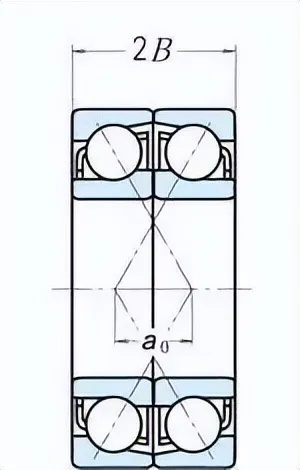
Two single-row angular contact ball bearings are mounted face-to-face, with their contact angles converging toward the axis of rotation. This reduces angular stiffness and effectively increases preload.

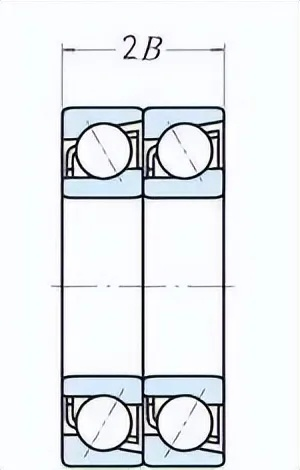
Two single-row angular contact ball bearings are mounted in tandem, with their contact angles parallel. This allows radial and axial loads to be evenly distributed across the bearings. However, this configuration usually only bears a single axial load force and is usually installed at opposite ends of the machine to balance and limit axial stability.

Triple Configuration:
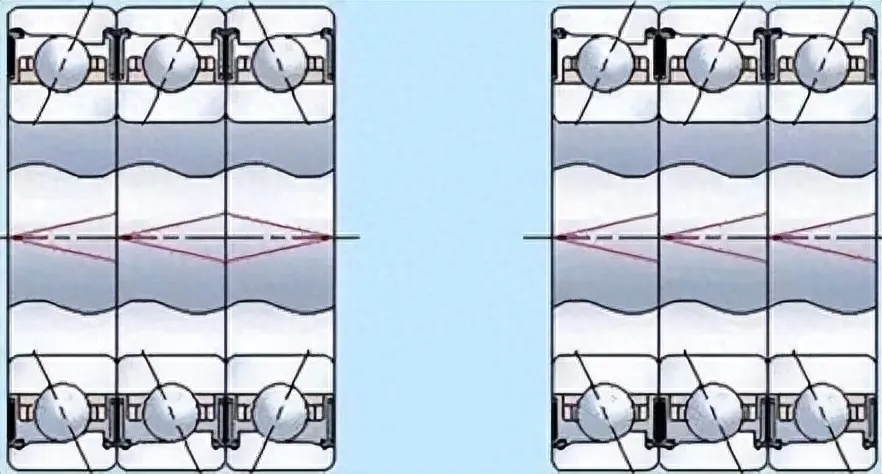
Three single-row angular contact ball bearings are mounted in a triple configuration, capable of supporting radial and axial loads in both directions. However, this type of assembly is prone to uneven load distribution, especially under high-speed rotation conditions, which can easily cause bearing damage. Therefore, it is usually not suitable for high-speed rotation working environments.

Quadruple Configuration:
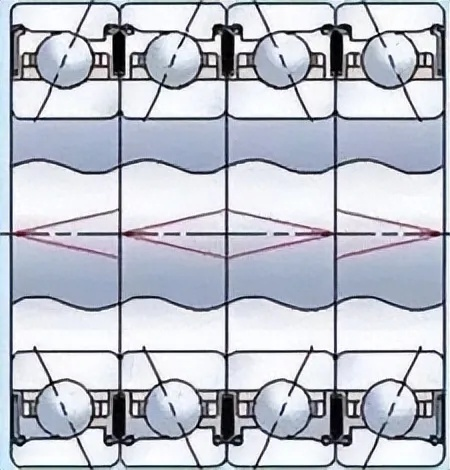
A quadruple arrangement of four single-row angular contact bearings can also simultaneously withstand radial and bidirectional axial loads. Under the same internal clearance, its preload and rigidity are twice that of ordinary assembly, so it can withstand a larger ultimate axial load.

Free configuration:
Free-matching angular contact ball bearings require strict control of the dimensional tolerances of the final ground surface of the outer ring, ensuring that the inner and outer rings are of equal width. This assembly method is used in precision machine tools and allows for a certain preload to be achieved after installation without complex adjustments.
In summary, angular contact ball bearings offer a variety of matching installation forms, including back-to-back, face-to-face, tandem, triple, quadruple, and free configurations. Each arrangement provides distinct mechanical characteristics and is suited for specific application scenarios. Selecting the appropriate pairing method requires comprehensive consideration of the actual operating conditions, load types, speed requirements, and precision needs of the equipment. This ensures optimal performance of the bearing system, extends service life, and meets the stringent demands for high speed, high rigidity, and high reliability in fields such as machine tools and precision machinery. For further assistance in bearing selection, it is recommended to consult with our professional engineers.

Copyright 2013-2025 Zhengzhou Sinomach Precision Industry Development Co., Ltd.