Angular contact ball bearings are essential components in modern machinery, offering superior performance in applications requiring both radial and axial load handling. Among them, single-row angular contact ball bearings stand out for their compact design and high-speed capabilities.
This article provides a detailed overview of their structure, function, and usage characteristics, helping engineers and technical professionals make informed decisions when selecting the right bearing solution.
Overview of Single-Row Angular Contact Ball Bearings
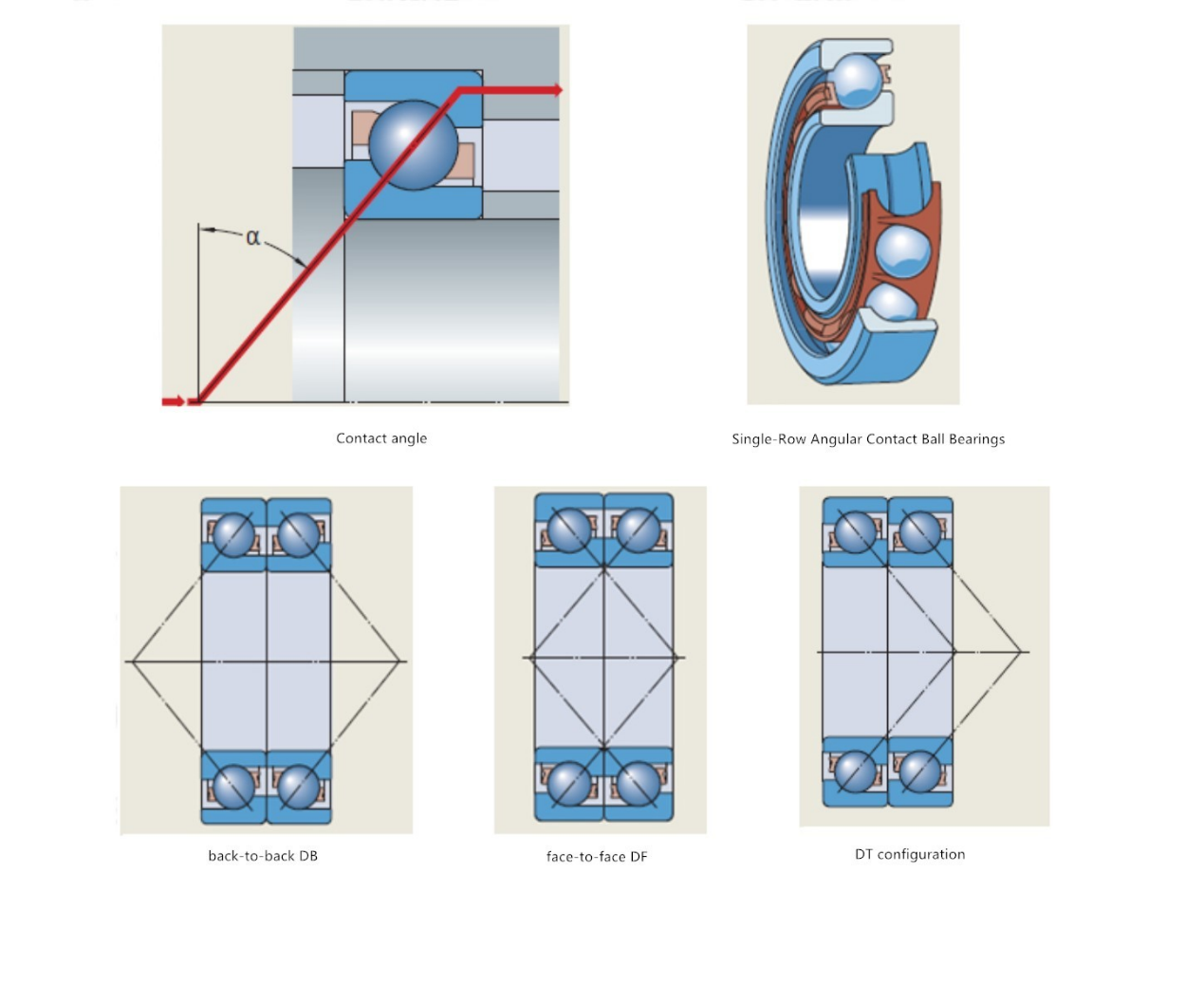
Single-row angular contact ball bearings are non-separable bearings, composed of an inner ring, outer ring, steel balls, and a cage assembly. These cages may be made from a variety of materials such as nylon, stamped steel sheet, brass, or phenolic laminated fabric.
A distinctive feature of these bearings is that the raceways of the inner and outer rings are offset along the horizontal axis. This design enables the bearing to support combined loads—both radial and axial forces—simultaneously. The ability to handle axial load increases with the contact angle of the bearing.
Contact Angle and Its Role
The contact angle is defined as the angle between the line connecting the contact points of the steel ball and the raceway and the vertical axis of the bearing, within the radial plane. Load is transmitted between the raceways along this line.
· Larger contact angles (e.g., 40°) result in higher axial load capacity.
· Smaller contact angles (e.g., 15°) are better suited for high-speed applications.
Axial Load Direction and Pairing Requirements
Single-row angular contact ball bearings can only withstand axial loads in one direction. When subjected to radial loads, they generate internal axial forces, which restrict axial movement in one direction only.
To accommodate axial loads in both directions, bearings are often installed in pairs:
· Back-to-back (DB): Wide end faces together – offers better moment load resistance.
· Face-to-face (DF): Narrow end faces together – better alignment capabilities.
These arrangements help eliminate additional axial forces and ensure reliable shaft positioning
Contact Angle Options
Standard contact angles available:
· 15°, 25°, 30°, and 40°
Each angle offers a trade-off between axial load capacity and speed adaptability, allowing engineers to choose based on specific operational requirements.
Internal Clearance and Preload Settings
Unlike deep groove ball bearings, single-row angular contact ball bearings do not have a standard initial clearance. Instead, internal clearance is pre-set to achieve the optimal contact angle.
During installation—often in pairs—clearance or preload is adjusted based on application needs:
· Preloaded bearings: Zero or negative clearance, enhancing rigidity and precision, especially in machine tool spindles.
· These preloads are typically factory-set to ensure consistency and ease of installation.
Universal Matching Bearings and Interchangeability
Standard single-row angular contact ball bearings are not interchangeable due to manufacturing tolerances. However, universal matching bearings are designed for flexible assembly:
· Can be configured back-to-back, face-to-face, or in tandem.
· Available in both preloaded and pre-clearance variants.
· Ensure consistency and interchangeability without compromising performance.
This versatility greatly simplifies stocking and assembly for manufacturers and maintenance teams.
Common Structural Configurations
Angular contact ball bearings come in various structural forms to suit different engineering needs. These may include open type, shielded, sealed, or bearings with snap ring grooves.
Conclusion: Reliable Performance for High-Precision Applications
Single-row angular contact ball bearings are a critical component in applications requiring high-speed rotation, precision, and the ability to handle axial and radial loads simultaneously.
With a variety of contact angles, preload options, and structural configurations, they offer engineers a flexible range of solutions for demanding environments such as:
· Machine tools
· Electric motors
· Pumps and compressors
· Gearboxes
· Robotics
Need Help with Selection or Customization?
We provide a comprehensive range of high-quality single-row angular contact ball bearings with customizable options to meet your exact engineering specifications.
Contact our expert team today for selection guidance, technical support, or a competitive quote.

Copyright 2013-2025 Zhengzhou Sinomach Precision Industry Development Co., Ltd.